Volleyball Bros Game Modes Explained: Solo vs 2 Player
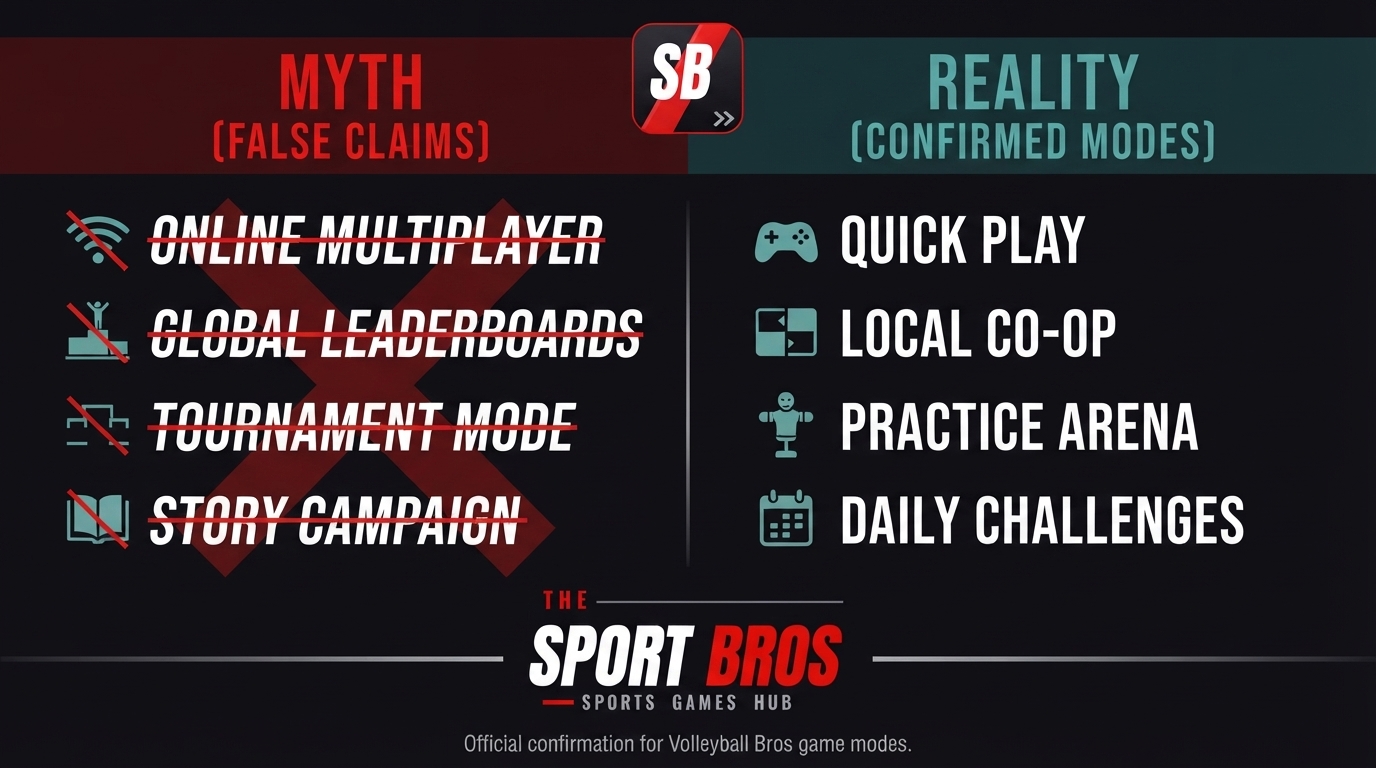
There are exactly two ways to play Volleyball Bros, and if you’ve read anywhere online that there’s a tournament bracket, online ranked play, or unlockable characters with special abilities, that site is wrong. Here’s what actually exists, what doesn’t, and why the confusion is out there in the first place.
The Only Two Real Modes
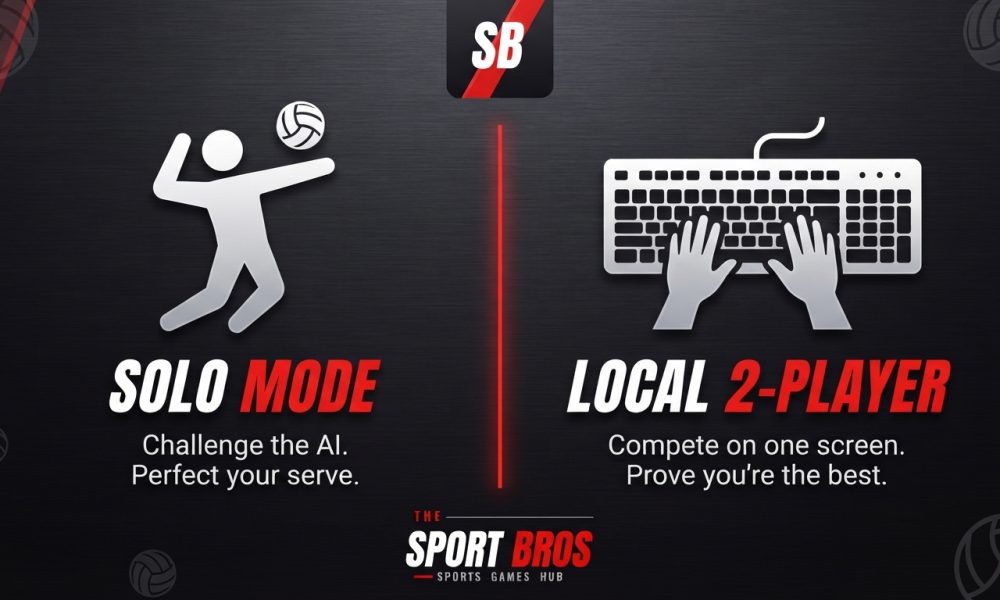
Volleyball Bros, the game people mean when they search that name, gives you Solo vs CPU and Local 2-Player on one keyboard. That’s the complete list. No online matchmaking, no tournament ladder, no character roster to pick from before a match. Every legitimate hosting of the game, from the official CrazyGames listing to RHM Interactive’s own TwoPlayerGames.org, agrees on this exact structure.
Solo Mode: You vs the CPU
Solo mode drops you into a match against a computer-controlled opponent, and it’s a better training ground than it sounds like. The AI reads the ball’s arc and times its jumps competently, which means lazy button-mashing gets punished just as fast as it would against a real person. This is the mode to spend your first several matches in, purely to build the instinct for timing your jump into the rising part of the ball’s arc before you’re dealing with a human opponent’s unpredictability on top of the game’s own randomness.
There’s no difficulty selector to speak of. You’re not choosing between an easy bot and a hard bot, you’re just playing the one CPU opponent the game gives you, which stays consistently sharp rather than scaling up or down.
Local 2-Player: The Mode the Game Is Built Around
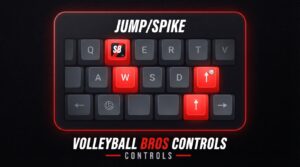
This is where Volleyball Bros actually earns its reputation. Two people share one keyboard, Player 1 on W, Player 2 on the Up Arrow, and play in real time with zero lag and zero matchmaking wait, because there’s nothing to connect to. The randomness that can feel slightly repetitive solo, a new ball type or court every point, becomes the entire source of the fun once there’s a real opponent reacting to the same chaos you are. Neither of you can fully control where the ball goes, which levels the playing field between a first-timer and someone who’s played fifty matches.
It’s built for exactly the situations you’d expect: a shared laptop in a study hall, two coworkers on a lunch break, siblings fighting over who gets which key. No accounts, no lobbies, just two people and a keyboard.
Solo vs 2-Player at a Glance
| Solo Mode | Local 2-Player | |
| Opponent | CPU | A real second player |
| Setup needed | None | Two people, one keyboard |
| Best for | Learning timing, quick practice | The actual intended experience |
| Skill ceiling | Fixed CPU difficulty | Scales with your opponent |
| Randomness impact | Same for you, CPU adapts instantly | Genuinely levels the field between players |
Modes That Don’t Actually Exist (Despite What Some Sites Claim)
Here’s the part worth reading carefully if you’ve bounced around a few different game-hosting sites researching this. Several lower-quality pages describe features that simply aren’t in the real game:
“Tournament Mode” with bracket progression. A few sites describe players advancing through rounds against increasingly difficult opponents in a structured bracket. No official hosting of the game has this. What you’re reading is either a description of a completely different game or auto-generated content that was never verified against the actual product.
“Online multiplayer” and “global leaderboards.” More than one site claims you can play ranked matches against strangers online or check a worldwide leaderboard. RHM Interactive’s own hub and every major host confirm the opposite: solo vs CPU or local 2-player only, no online matchmaking. One site hedged this as “some versions include light online features,” which is exactly the kind of vague, unverifiable claim worth ignoring entirely.
Character selection with unique abilities. A couple of listings describe picking characters with different strengths before a match. There’s no roster or character select screen in the real game. Everyone plays the same ragdoll physics regardless of which host you’re using.
WASD movement, spacebar jumps, and separate spike or serve keys. This is the biggest tell that a site copy-pasted a generic sports-game template without checking it. The real control scheme is one button per player, full stop. If a page is describing multiple keys for movement, spiking, and serving, it’s either describing an entirely different game or it’s simply inaccurate.
One more small inconsistency worth flagging: most sources agree matches go to five points, but at least one host claims six. Five is the standard across every major and official listing, so treat any other number as an outlier until proven otherwise.
Why This Confusion Exists
Browser game-listing sites often auto-generate or template descriptions across huge catalogs of games to save time, and volleyball, sports, and arcade games in general share a lot of generic descriptive language, movement keys, spike buttons, tournament brackets, that gets recycled without anyone actually confirming it against the specific game being described. Volleyball Bros has the added complication of not being an officially named title in the first place, which makes it even easier for inaccurate, copy-pasted descriptions to spread unchecked. If a page reads like it could describe fifty other sports games with the name swapped out, that’s usually exactly what happened.
Choosing the Right Mode for Your Situation
Go solo if you’re alone, killing five minutes between classes, or want to build your timing before playing someone else. Go local 2-player the moment you’ve got a second person and a shared device, since that’s genuinely where the game is best. If you’re trying to decide how to spend a short break, solo mode’s fixed CPU difficulty means you always know roughly what you’re getting, while 2-player against a friend who’s improving fast can turn one quick match into an hour without you noticing.

Build Your Own “Tournament” Since There Isn’t a Real One
Since there’s no official bracket mode, here’s the honest alternative if you want that structure with friends. Grab three or more people, set up a winner-stays-on rotation where the winner keeps the keyboard and the next challenger steps in, and track wins on paper or a phone note. Because matches run just a couple of minutes each, you can realistically run a full mini-tournament with six or eight people during a single lunch break. It’s not an in-game feature, but it delivers the same competitive structure the fake “Tournament Mode” claims are describing, just organized by you instead of the game.
Common Mistakes Around Game Modes
- Searching for a mode select screen that doesn’t exist. There’s no menu tree beyond choosing solo or 2-player. If you’re hunting for more options, you’re not missing a hidden menu, there simply isn’t one.
- Expecting online play to work. If a site promised online multiplayer and you can’t find it, that’s not a bug on your end, the feature was never real to begin with.
- Assuming a “harder” CPU exists. There’s no difficulty toggle. If solo mode feels easy or hard, that’s the one CPU behavior the game has, not a setting you missed.
- Trusting the first result you land on. Given how much inaccurate mode information is floating around, cross-check anything surprising against an official listing or a well-sourced guide before assuming it’s true.
Expert Tips
Treat solo mode as a warm-up, not the main event, five or six quick matches is usually enough to shake off rust before bringing a friend in. When playing local 2-player, agree on seating and hand position before the match starts, cramped keyboards can cause accidental key overlap if both players’ hands are too close together. And if you’re setting up a mini-tournament using the winner-stays-on format, cap each match at best-of-three rather than single elimination, since the game’s randomness means a single unlucky bounce shouldn’t be enough to knock a strong player out immediately.
A Quick Caution
This breakdown reflects the confirmed mode structure as of mid-2026, sourced from RHM Interactive’s own hub and every major legitimate host. If the developer ever does add online play, a tournament structure, or character variety in a future update, that would be a genuine change worth revisiting this article for, not something currently available despite what some listing sites claim.
FAQ
How many game modes does Volleyball Bros have? Two. Solo mode against a CPU opponent, and local 2-player on one keyboard. There’s no tournament mode, online multiplayer, or character selection in the real game.
Does Volleyball Bros have online multiplayer? No, not in any officially confirmed version. Some low-quality sites claim otherwise, but every major host, including RHM Interactive’s own hub, confirms only solo and local 2-player exist.
Is there a tournament mode in Volleyball Bros? No official tournament mode exists. A few sites describe one, but this isn’t backed up by the actual game or its developer. You can build your own bracket-style structure with friends instead.
Can you choose different characters in Volleyball Bros? No. There’s no character select screen or roster of abilities. Every match uses the same ragdoll physics regardless of which legitimate site you’re playing on.
Is solo mode harder or easier than playing a friend? Neither exactly, they’re different challenges. The CPU in solo mode has fixed, competent difficulty, while a human opponent in 2-player brings unpredictability the CPU doesn’t.
Why do some websites describe modes that don’t exist in Volleyball Bros? Many game-listing sites use templated or auto-generated descriptions across large catalogs without verifying details against the specific game, which is how inaccurate claims like tournament brackets spread.
Final Verdict
Two modes, solo and local 2-player, is genuinely all Volleyball Bros needs, and it’s worth being skeptical of any page telling you otherwise. The game’s whole appeal is how little setup stands between you and a match, and a tournament bracket or online lobby would work against that simplicity, not improve it. If you want more structure, build it yourself with a winner-stays-on rotation and a group of friends. That gets you everything the fake “Tournament Mode” claims promise, minus the feature that was never actually there.