Your Rankings Are Already Out of Date
Not being dramatic. Two things happened in the last 24 hours that move the board, and almost every top-ranked article you’ll read today was published before either of them. There you will see the Fantasy Football Rankings 2026.
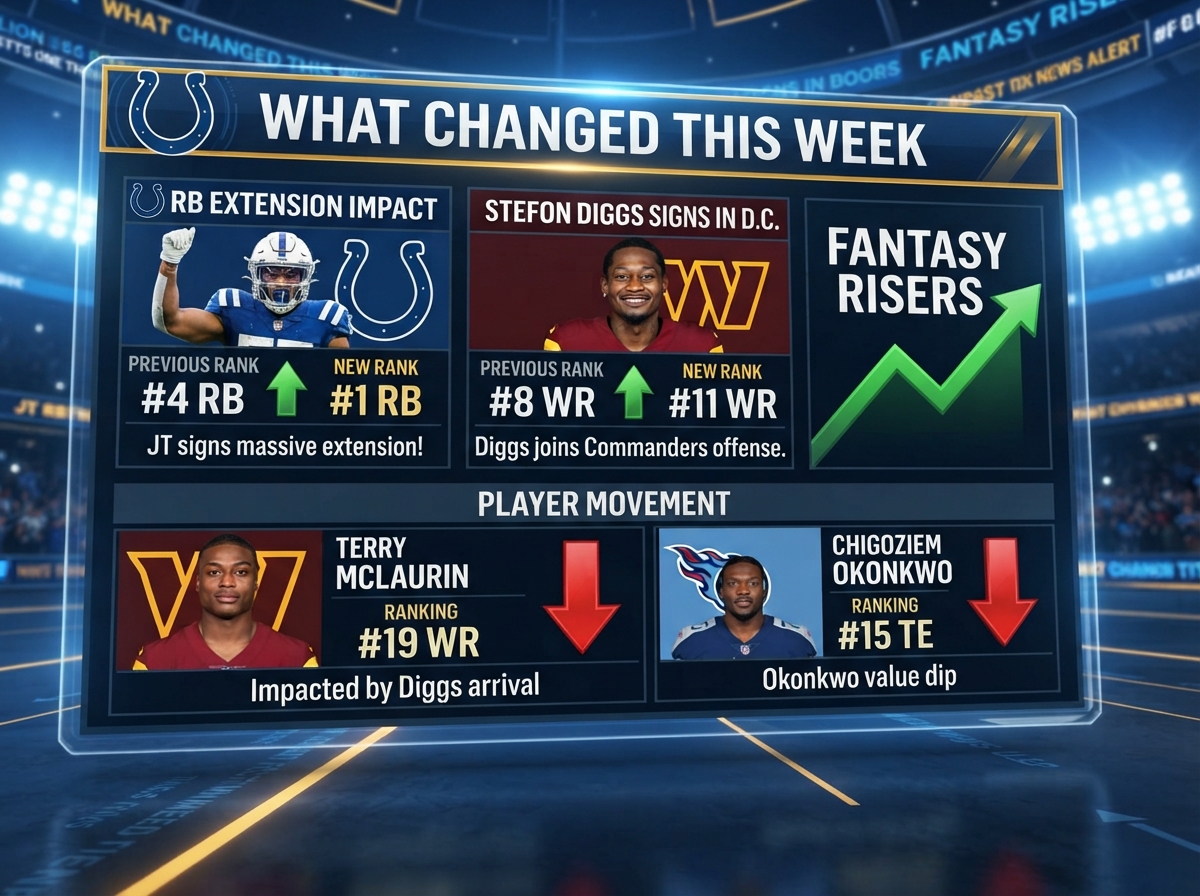
Jonathan Taylor signed a two-year, $44 million extension with the Colts this morning. Adam Schefter reported it can reach $47 million with $39 million guaranteed. Ian Rapoport called it the largest third contract ever given to an NFL running back. Translation for your draft: Indianapolis just told the entire league Taylor is the bell cow, and DJ Giddens and Seth McGowan are handcuffs, not a committee.
Stefon Diggs signed with the Commanders yesterday, a one-year deal worth up to $12 million per Schefter. He was ranked around 205th overall on most consensus boards as recently as last week because he was an unsigned free agent. He is now the WR2 in a real offense.
So here’s what you’re getting: our top 50 for PPR redraft, updated as of two hours ago. The values, the fades, an actual draft-day process, and the mistakes that torch more leagues than bad luck ever does.
Let’s go.
What Changed This Week (And Who It Moves)
Before the rankings, the news that actually shifts values. This is the stuff that separates a live board from a stale one.
Jonathan Taylor, RB, Colts. Moves up. The extension removes any workload ambiguity. He’s a top-six overall pick again.
Stefon Diggs, WR, Commanders. Moves way up, from undraftable to a real WR4 with weekly starter upside. He posted 85 catches for 1,013 yards and four scores across 17 games with New England in 2025, which is a genuine bounce-back from a torn ACL. An NFL personal conduct review closed in the spring without a finding, which removed the suspension risk that had been suppressing his market. He’s a Gaithersburg, Maryland native and a former Terp, so the fit was always logical.
Terry McLaurin, WR, Commanders. Moves down slightly. He’s still the alpha, but a 100-catch season just got harder with Diggs absorbing targets.
Chig Okonkwo, TE, Commanders. Moves down. Every “Okonkwo is the number two option in Washington” sleeper take you read this week was written before Tuesday night. That thesis is dead.
Ricky Pearsall, WR, 49ers. Season over. San Francisco’s receiver room has become a genuine disaster area, with a quad strain to Mike Evans and a calf strain to Christian Kirk on top of it. They signed Deebo Samuel Sr. off the street to stop the bleeding.
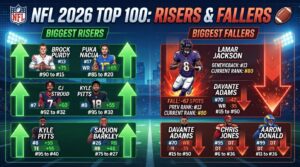
Brock Purdy, QB, 49ers. Moves down. He has lost all three of his top receivers from last season and multiple 2026 starters are banged up. Fade him.
Malik Nabers, WR, Giants. Moves up. He practiced last week for the first time since his ACL tear and was not placed on PUP to open camp. His ADP has already climbed roughly 10 spots in a week. There was a second procedure during rehab, so build in a slow ramp, but the talent is WR1 caliber.
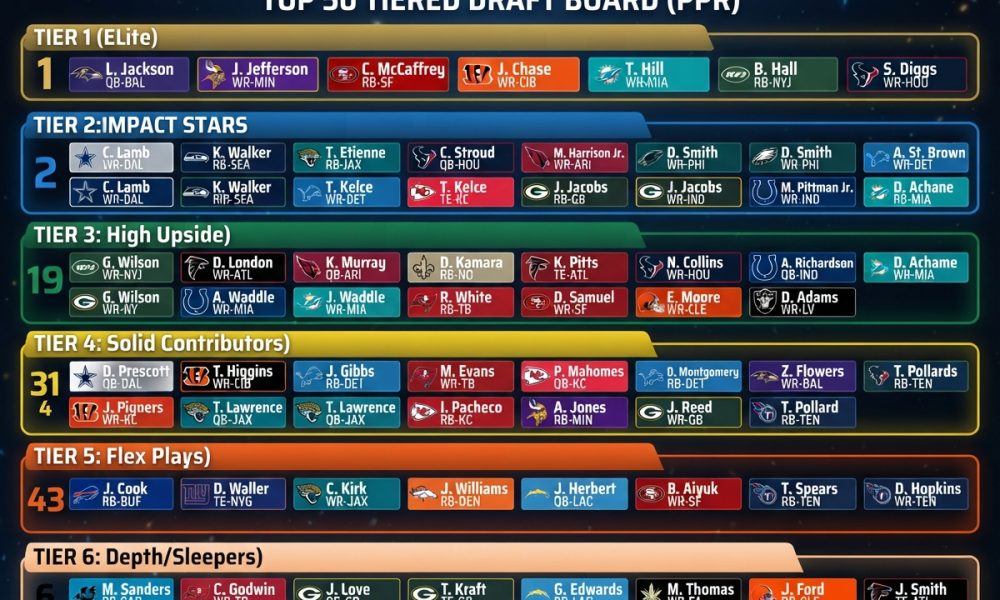
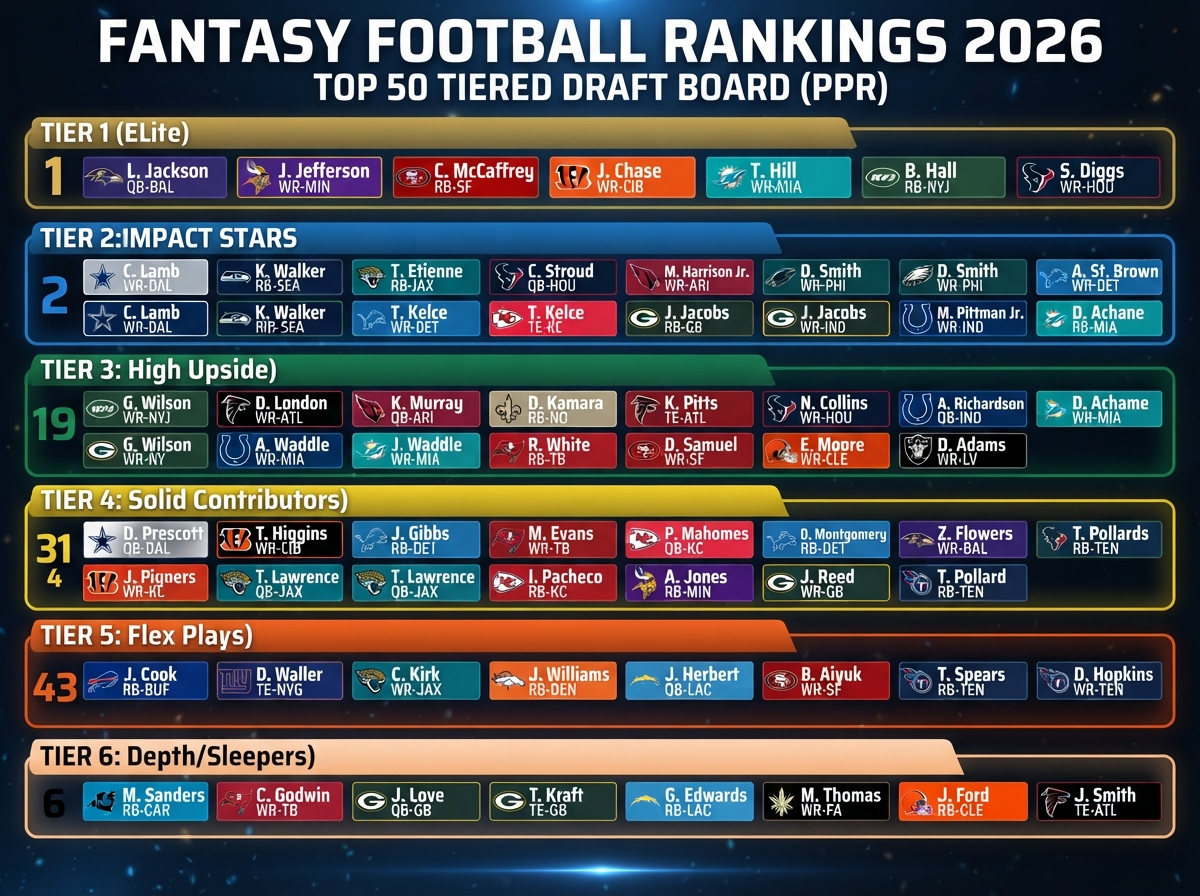
Fantasy Football Rankings 2026: Top 50 Overall (PPR)
Single-quarterback, full PPR redraft. Tiers matter more than exact numbers. When a tier empties, that’s your signal to move.
| # | Player | Pos | Team | Tier |
|---|---|---|---|---|
| 1 | Jahmyr Gibbs | RB | DET | Elite |
| 2 | Ja’Marr Chase | WR | CIN | Elite |
| 3 | Jaxon Smith-Njigba | WR | SEA | Elite |
| 4 | Bijan Robinson | RB | ATL | Elite |
| 5 | Puka Nacua | WR | LAR | Elite |
| 6 | Jonathan Taylor | RB | IND | Elite |
| 7 | Justin Jefferson | WR | MIN | Tier 2 |
| 8 | Amon-Ra St. Brown | WR | DET | Tier 2 |
| 9 | James Cook III | RB | BUF | Tier 2 |
| 10 | CeeDee Lamb | WR | DAL | Tier 2 |
| 11 | De’Von Achane | RB | MIA | Tier 2 |
| 12 | Nico Collins | WR | HOU | Tier 2 |
| 13 | A.J. Brown | WR | NE | Tier 2 |
| 14 | Ashton Jeanty | RB | LV | Tier 3 |
| 15 | George Pickens | WR | DAL | Tier 3 |
| 16 | Trey McBride | TE | ARI | Tier 3 |
| 17 | Emeka Egbuka | WR | TB | Tier 3 |
| 18 | Omarion Hampton | RB | LAC | Tier 3 |
| 19 | Christian McCaffrey | RB | SF | Tier 3 |
| 20 | Chris Olave | WR | NO | Tier 3 |
| 21 | Saquon Barkley | RB | PHI | Tier 3 |
| 22 | Drake London | WR | ATL | Tier 4 |
| 23 | Brock Bowers | TE | LV | Tier 4 |
| 24 | DeVonta Smith | WR | PHI | Tier 4 |
| 25 | Garrett Wilson | WR | NYJ | Tier 4 |
| 26 | Josh Allen | QB | BUF | Tier 4 |
| 27 | Chase Brown | RB | CIN | Tier 4 |
| 28 | Zay Flowers | WR | BAL | Tier 4 |
| 29 | Derrick Henry | RB | BAL | Tier 4 |
| 30 | Malik Nabers | WR | NYG | Tier 4 |
| 31 | Breece Hall | RB | NYJ | Tier 5 |
| 32 | Rashee Rice | WR | KC | Tier 5 |
| 33 | Lamar Jackson | QB | BAL | Tier 5 |
| 34 | Kyren Williams | RB | LAR | Tier 5 |
| 35 | Tetairoa McMillan | WR | CAR | Tier 5 |
| 36 | Colston Loveland | TE | CHI | Tier 5 |
| 37 | Jaylen Waddle | WR | DEN | Tier 5 |
| 38 | Joe Burrow | QB | CIN | Tier 5 |
| 39 | Kenneth Walker III | RB | KC | Tier 5 |
| 40 | Javonte Williams | RB | DAL | Tier 5 |
| 41 | Tee Higgins | WR | CIN | Tier 6 |
| 42 | Ladd McConkey | WR | LAC | Tier 6 |
| 43 | Drake Maye | QB | NE | Tier 6 |
| 44 | Cam Skattebo | RB | NYG | Tier 6 |
| 45 | Jeremiyah Love | RB | ARI | Tier 6 |
| 46 | Davante Adams | WR | LAR | Tier 6 |
| 47 | Terry McLaurin | WR | WAS | Tier 6 |
| 48 | Luther Burden III | WR | CHI | Tier 6 |
| 49 | Jameson Williams | WR | DET | Tier 6 |
| 50 | Josh Jacobs | RB | GB | Tier 6 |
Where we differ from the consensus, and why:
Jonathan Taylor at 6 is higher than most boards, which had him seventh or eighth before this morning. The extension is the difference.
Christian McCaffrey at 19 is dramatically lower than PFF and ESPN, who have him third overall. He turned 30, he handled a league-leading 413 touches last season excluding playoffs, and he’s topped 2,000 total yards three times now. The first two times, the following season fell apart. San Francisco’s receiver injuries also mean defenses get to load up on him. That’s a lot of red flags for a first-round pick.
Terry McLaurin at 47 is a post-Diggs adjustment nobody else has made yet.
Mike Evans is not in our top 50. He’s on the 49ers now, he has a quad strain, and the offense around him is falling apart. Most boards still have him in the mid-40s.
Positional Tier Comparison: When to Attack Each Spot
This is the table that actually wins drafts. Positional scarcity is the whole game.
| Position | Elite Tier Size | Where the Cliff Is | Draft Window | Verdict |
|---|---|---|---|---|
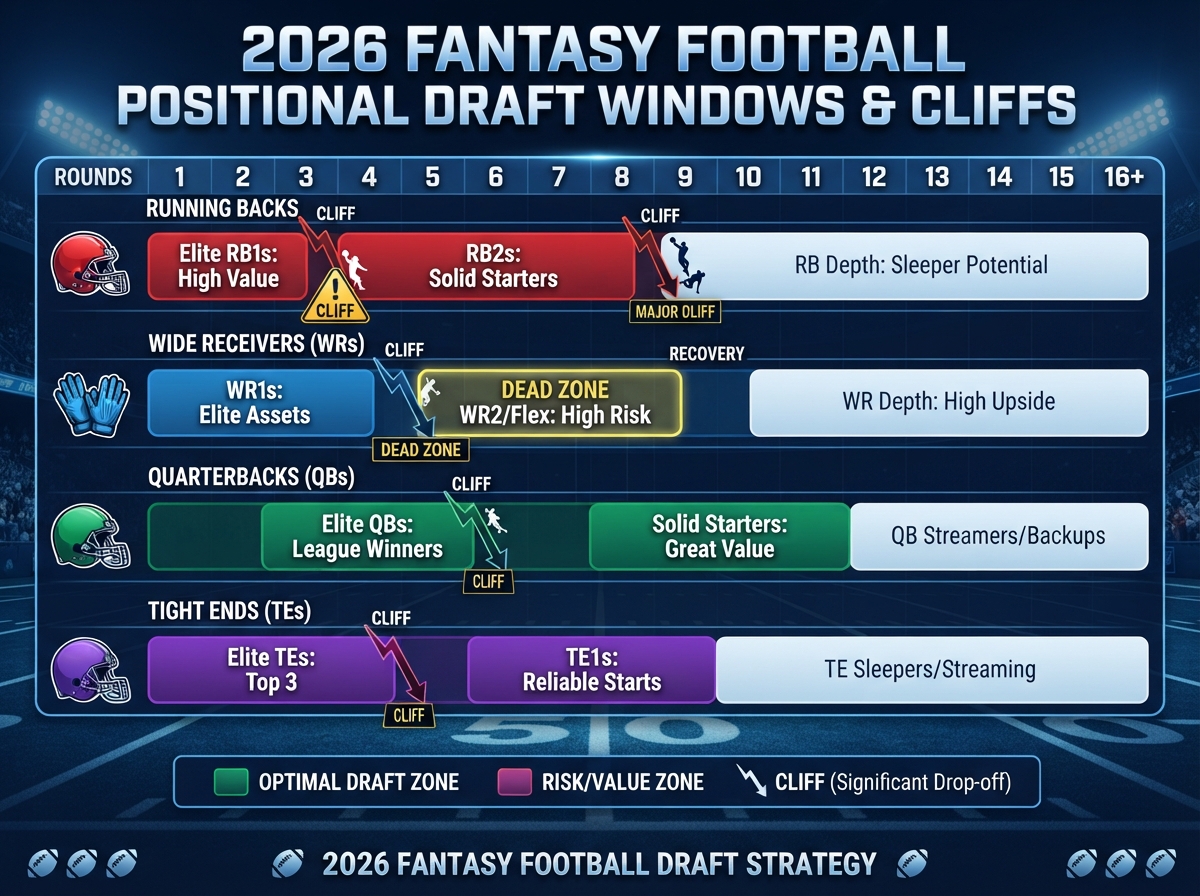
| Running Back | 6 (Gibbs through Taylor) | After RB13 or so, the “dead zone” begins | Rounds 1-3, then wait | Scarcest position. Get one early or commit to zero. |
| Wide Receiver | 5, then a long useful tail | No real cliff until WR40+ | Anywhere | Deepest position. Late-round gems are real here. |
| Quarterback | Nonexistent gap | QB1 to QB12 is a few points per game | Rounds 8-12 | Waiting is almost always correct in 1QB. |
| Tight End | 2 (McBride, Bowers) | Immediately after those two | Round 3-4 or Round 12+ | Barbell it. Pay up or punt entirely. |
| Defense | None | None | Last two rounds | Stream by matchup. Never draft early. |
| Kicker | None | None | Literally last round | If you draft a kicker before the final round, we can’t help you. |
That quarterback row deserves emphasis. Josh Allen was the top-scoring fantasy quarterback last season and only outscored the QB12 by about 3.3 points per game. Three points. That’s the entire cost of your fourth-round pick. Meanwhile the gap between RB1 and RB24 is enormous.
Six Players Going Way Too Late
Stefon Diggs, WR, Commanders. The obvious one. He’ll be free in most drafts happening this weekend because half your league won’t have seen the news. He was a 1,000-yard receiver last season on a Super Bowl team.
Emeka Egbuka, WR, Buccaneers (ADP: WR14). He was a top-three fantasy receiver over the first five weeks of last season before fading. With Mike Evans gone to San Francisco, the alpha role is his. Top-10 upside at a WR14 price.
Justin Jefferson, WR, Vikings (ADP: WR5). His down 2025 was a J.J. McCarthy problem, not a Jefferson problem. Kyler Murray is the expected starter now. He has a real path to overall WR1.
Omarion Hampton, RB, Chargers (ADP: RB9). His rookie year got wrecked by an ankle injury, but he was pacing toward roughly 1,400 total yards. Jim Harbaugh is going to run the football. This is not complicated.
Javonte Williams, RB, Cowboys (ADP: RB16). He went over 1,200 rushing yards with 11 rushing touchdowns last season and finished inside the top 12 PPR backs. He’s priced as an RB2 with RB1 output already on tape.
Chuba Hubbard, RB, Panthers (ADP: RB28). He lost the job to Rico Dowdle last year. Dowdle is in Pittsburgh now. His remaining competition is Jonathon Brooks, who has played three games in two NFL seasons. Volume is sitting right there.
Five Players We’re Not Touching
Christian McCaffrey, RB, 49ers (ADP: RB3). Covered above. Age, workload, history, and a collapsing receiver room. First-round picks should not carry this much risk.
Drake London, WR, Falcons (ADP: WR7). Genuinely good player. But he’s topped 1,000 receiving yards once in four seasons, and Atlanta’s quarterback situation is a Michael Penix versus Tua Tagovailoa camp battle. You’re paying his absolute ceiling.
Rashee Rice, WR, Chiefs (ADP: WR11). Twelve games played across the last two seasons combined, plus knee surgery this offseason. The talent is real and so is the availability problem.
Jeremiyah Love, RB, Cardinals (ADP: RB13). Third overall pick, exciting player, terrible situation. This is the exact trap Ashton Jeanty was last year: a good back on a bad team where the game script never lets him run.
Jayden Daniels, QB, Commanders (ADP: QB5). The Diggs signing helps, and we’ll say that honestly. But 2025 was an injury-marred regression across the board, and QB5 assumes the rookie-year version returns. Let someone else find out.
How to Actually Run Your Draft
Not vibes. A process.
Step 1: Check your league settings before you rank anything. Full PPR, half PPR, and standard produce genuinely different boards. Superflex changes quarterback value completely. TE premium moves McBride and Bowers up a full round. Do this first or everything below is wrong.
Step 2: Build tiers, not a list. Write down where each positional group breaks. You are not drafting the highest-ranked player. You are drafting the last player in a tier before it empties.
Step 3: Lock your first four rounds around scarcity. Take running backs and receivers. Do not take a quarterback. Do not take a defense. The only exception is McBride or Bowers if one falls to the back of round three.
Step 4: Navigate the dead zone deliberately. Rounds five through eight are where running backs go to die. Bust rates spike here relative to receivers. Either attack pass-catchers or specifically target backs with a clear path to volume, like Hubbard.
Step 5: Take your quarterback rounds eight to twelve. Dak Prescott at QB9 and Trevor Lawrence at QB10 are the exact profile you want. Good offense, no premium price.
Step 6: Swing on upside in the last six rounds. Jalen Nailor is the likely WR1 in Las Vegas and goes around round 13. Jalen Coker got roughly $12 million a year from Carolina this offseason and is being drafted as WR56. These are your league-winners.
Step 7: Kicker and defense in your final two picks. No exceptions. Draft a defense with a soft Week 1 matchup and drop them the second it dries up.
Draft Strategy: Pros and Cons
Three main approaches, and none of them is universally correct.
Zero RB
Pros: Receivers bust less in PPR. You get elite pass-catchers at a discount because the room panics over running backs. Backfield injuries create free league-winners on waivers every single year.
Cons: If your late-round backs don’t hit, your flex is a black hole for four months. Requires aggressive waiver management. High variance, and a bad start can sink your season before you can fix it.
Hero RB
Pros: One elite anchor plus receiver depth is the best floor-to-ceiling balance available. You get a top-six back without needing two.
Cons: You’re heavily exposed to one injury. If Gibbs or Taylor goes down in Week 4, the entire structure collapses.
Robust RB
Pros: In a league where everyone else fades running backs, you control the scarcest asset. Trade leverage all season is real and underrated.
Cons: You’re paying premium prices at the position with the highest injury rate in football, and you’ll be starting a WR3 you don’t like every week.
Our read: Hero RB is the most defensible default in 2026 because the elite running back tier is only six deep and the receiver tail is unusually long.
Common Draft Mistakes
Drafting a quarterback in the first five rounds. Three points per game between QB1 and QB12. That’s the whole argument. Stop.
Reaching for last year’s points. Fantasy scoring is descriptive, not predictive. Opportunity is predictive. Ask who gets the touches, not who got them.
Ignoring bye weeks until it’s too late. Detroit and Cincinnati both bye in Week 6. Arizona and Dallas both bye in Week 14, which is usually a playoff week. Stacking those is how you lose a semifinal you earned.
Using a board someone published two weeks ago. The Diggs signing and the Taylor extension both happened this week. Camp injuries land daily. A ranking with no update timestamp is a ranking you shouldn’t trust.
Handcuffing your own backs instead of drafting other teams’ backups. Handcuffing your RB1 protects a floor. Drafting the backup to someone else’s fragile RB1 creates trade leverage and a genuine league-winner.
Confusing a good real-life team with a good fantasy situation. Balanced offenses spread touches. Bad teams throw constantly in the second half. Garbage time points count exactly the same.
Expert Tips
Track PUP list decisions, not camp highlight videos. Malik Nabers not being placed on PUP told you more about his outlook than any practice clip. That is a medical staff making a formal declaration.
Buy players whose target competition just left town. Egbuka lost Mike Evans. Hubbard lost Rico Dowdle. This is the single most reliable value signal in August.
Sell players whose target competition just arrived. McLaurin and Okonkwo, this week. The market takes several days to catch up.
Draft the second-year receiver breakout, not the rookie. Luther Burden III and Tetairoa McMillan are entering year two with a defined role. Rookie receivers are lottery tickets.
Treat contract news as workload news. Taylor’s extension is a usage signal disguised as a business story. Teams do not pay record money to running backs they plan to rotate.
If you’re drafting this weekend, draft Diggs. He’ll go undrafted in a meaningful percentage of leagues purely because of news lag. That’s free money.
FAQ
Who is the number one overall pick in 2026 fantasy football? Jahmyr Gibbs is our RB1 and overall 1.01, largely because Detroit’s offense is consistently excellent. PFF also has Gibbs first. ESPN’s Field Yates has Bijan Robinson at number one with Gibbs second. Either is defensible, and both are running backs.
When should I draft a quarterback in 2026? Rounds eight through twelve in standard one-quarterback leagues. The gap between the top quarterback and the QB12 was only about 3.3 fantasy points per game last season, which does not justify an early pick. Superflex leagues are completely different and require an early quarterback.
Is Stefon Diggs worth drafting in 2026? Yes. He signed with Washington on August 5 for up to $12 million on a one-year deal and slots in as the WR2 opposite Terry McLaurin. He posted 85 catches for 1,013 yards last season. Most rankings still list him as an unsigned free agent, so he’s available late.
Who are the best fantasy football sleepers for 2026? Emeka Egbuka now that Mike Evans is gone, Chuba Hubbard with Rico Dowdle in Pittsburgh, Jalen Nailor as the likely Raiders WR1 at a 13th-round price, and Jalen Coker in Carolina. Each has a clear path to volume that ADP hasn’t priced in yet.
Should I draft Christian McCaffrey in the first round? We wouldn’t. He’s 30, he handled a league-leading 413 touches last season, and his history after 2,000-yard seasons is rough. The 49ers receiver room is also decimated. He’s our RB9 and 19th overall, which is well below his RB3 average draft position.
How many running backs should I draft? Four to six in a standard twelve-team league. The elite tier is only six deep and the middle rounds are a bust minefield, so you want volume at the position later even if you invest early. Wide receiver depth is far easier to find on waivers.
When does the 2026 NFL season start? Wednesday, September 9, 2026, with a Super Bowl LX rematch as New England visits Seattle. The Hall of Fame Game between the Cardinals and Panthers kicks off tonight, August 6, and preseason Weeks 1 through 3 run August 13 to August 29.
What is the RB dead zone? The stretch in the middle rounds, roughly rounds five through eight, where running back bust rates spike dramatically compared to receivers taken at the same cost. Most managers are better served taking pass-catchers there and finding backfield value later.
The Verdict
Three actual opinions before you go draft.
Take a running back with your first pick. The elite tier is six deep and then it falls off a cliff. Receiver is the deepest it has been in years, which means you can wait there and you cannot wait at back.
McCaffrey is the trap of the year. Somebody in your league is going to spend a top-five pick on the name. Let them. Thirty years old, 413 touches, and a receiver corps held together with tape.
And go get Diggs. A 1,000-yard receiver just landed in a real offense two days before your draft, and half the internet’s rankings haven’t updated. That is the single easiest edge available to you this week.
Good luck. Go win the thing.